By the time most buyers have a genuine shortlist of two properties, they have been looking for months. And yet the final comparison tends to dissolve into a loop: another viewing, another pros-and-cons list, another evening of “but what about the garden”. This is the framework that gets you out of the loop and to a decision you can defend — to yourself, to your partner, and to the version of you living in the house in five years.
Why the final two is the hardest decision of the whole search
Early in a search, elimination is easy. Wrong area, too small, over budget — gone. But properties that survive to a final shortlist have already passed every filter you know how to apply. What remains are two homes that are both, genuinely, good enough. The differences left are the hard kind: incommensurable trade-offs like a shorter commute versus a bigger kitchen, where no amount of staring at the listings tells you which one wins.
Three things make this stage worse than it needs to be:
- Decision fatigue: After six or more viewings, properties blur. Buyers routinely misremember which house had the small third bedroom and which had the north-facing garden. Your judgement at viewing eight is measurably worse than at viewing two — and this is exactly when the biggest decision lands.
- Confirmation bias: Most buyers develop a favourite early — often within minutes of the first viewing — and then spend their “analysis” collecting evidence for it rather than testing it. If you notice yourself explaining away one property's flaws while cataloguing the other's, that is not a decision process; that is a justification process.
- The unweighted pros-and-cons list: The classic two-column list fails because it treats every line equally. “Has a utility room” and “40 minutes further from your mother” each take up one line, when one of them might matter ten times more than the other. A longer pros column tells you which property has more listable features, not which one you should buy.
Step 1: Weight your criteria before you view again
Before your second viewing of either finalist, sit down — with your co-buyer if you have one — and write your criteria in four tiers. Do this away from the listings, so you are describing your life, not reacting to a photograph.
- Non-negotiable: If a property fails this, it is out, however charming. Examples: commute under 40 minutes; at least two double bedrooms; within a school catchment you have actually verified.
- High priority: Failing this needs to be compensated by something substantial. Examples: a garden that gets afternoon sun; a room that works as a permanent office.
- Medium priority: Genuinely valuable, genuinely tradeable. Examples: off-street parking; a kitchen you will not want to replace within five years.
- Nice-to-have: Would sway a dead heat and nothing more. Examples: a period fireplace; being chain-free.
Two rules make this work. First, cap the non-negotiables at three or four — if everything is non-negotiable, nothing is. Second, if you are buying with someone, write your tiers separately and then compare. The most common source of the going-in-circles feeling is two buyers optimising for different criteria without ever having said so out loud.
Step 2: Use the second viewing to collect facts, not feelings
You already know how each property feels — that is what got it onto the shortlist. The second viewing is for the things the listing does not tell you. Take a checklist and fill it in for both properties, the same way, on the same day if you can:
- Connectivity: Check your actual mobile signal in the living room and the main bedroom, and look up the property's broadband availability while you are standing in it — full-fibre availability varies street by street.
- The boiler: Age, service history, and where it is. A boiler at end-of-life is a four-figure cost in year one and a legitimate negotiating point.
- Windows and damp: Condensation between double-glazing panes means failed units. Check external walls behind furniture, ceilings in corners, and the smell in cupboards — viewing-day air freshener is a classic tell.
- What surrounds it: What is above, below, and adjacent? Visit at a different time of day than your first viewing. A street that is quiet at 11am on a Saturday can be a rat-run at 8am on a Tuesday.
- The parking reality: “On-street parking” in the listing means nothing until you have seen the street at 7pm on a weekday.
- Storage: Count actual cupboards. Storage is the most common thing buyers say they underestimated, and the hardest to retrofit.
Step 3: Add the numbers the listings leave out
The asking prices are only the start of the cost comparison. For each property, put real figures against:
- Price per square metre: Divide asking price by floor area (it is on the EPC if the listing omits it). This is the single fastest way to see which property is expensive for what it is, and it regularly contradicts gut feel.
- Sold prices, not asking prices: Land Registry sold-price data for the same street or block tells you what the market actually pays. An asking price is a negotiating position.
- Running costs: Council tax band, EPC rating (and what heating that translates to in pounds per month), service charge and ground rent if leasehold. A £15,000 gap in asking price can be erased by five years of a £250/month service charge difference.
- Getting-to-work costs: Not just time — money. Price the actual season ticket or fuel for each address over a year. Multiply by five for a sense of the horizon you will own the house across.
Step 4: Apply the weights and let the table speak
Now score both properties against your tiered criteria — facts from steps 2 and 3, weights from step 1. You are not looking for a points total to two decimal places. You are looking for one of three outcomes:
- A non-negotiable failure. One property fails a top-tier criterion you had been quietly excusing. This happens more often than you would expect once the criterion is written down. Decision made.
- A clear winner on the high-priority tier. If one property takes most of the top two tiers, the nice-to-haves pulling you the other way are noise. Decision made.
- A genuine dead heat. Rare, but real. If the weighted comparison is truly level, then — and only then — feelings are the right tie-breaker, because you have established that the facts do not separate them. Buy the one you keep thinking about. You will live there, not in the spreadsheet.
The question that ends most loops
If you are still circling after all of this, ask: “If the other property did not exist, would I be happy to buy this one tomorrow?” Ask it about each property in turn. Buyers frequently discover the answer is “yes” for one and “I suppose so” for the other — which was the decision, hiding behind the comparison.
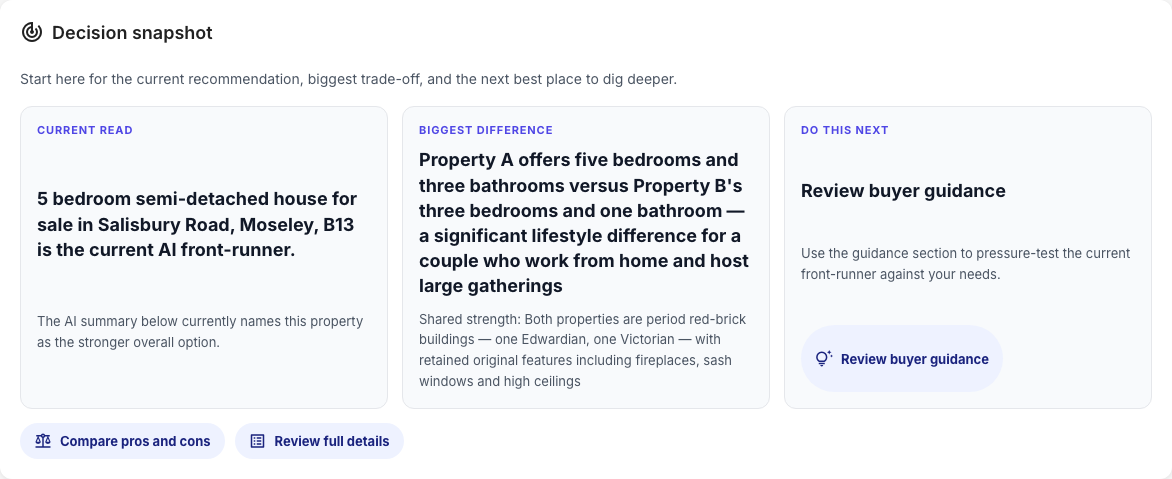
This structured side-by-side is exactly what HomesToCompare is built for: both properties in one view, the facts aligned row by row, with AI reasoning that applies your buyer context — your commute, your budget, your non-negotiables — to surface which trade-offs actually matter and which are noise.